Ultrasonic Leak Detector for Gas, Air and Water Systems
-
Code:63524
-
Weight:0.670 Kgs
Overview:
✔ Professional ultrasonic leak detector for leak diagnostics
✔ Suitable for gas, air, pressure and vacuum systems
✔ Detects leaks in pressurized and non-pressurized containers
✔ Includes ultrasonic transmitter, receiver and headphones
✔ Optical and acoustic leak indication
✔ Frequency response: 40 kHz ±2 kHz
✔ Compact and lightweight design for workshop use
✔ Suitable for professional diagnostic applications

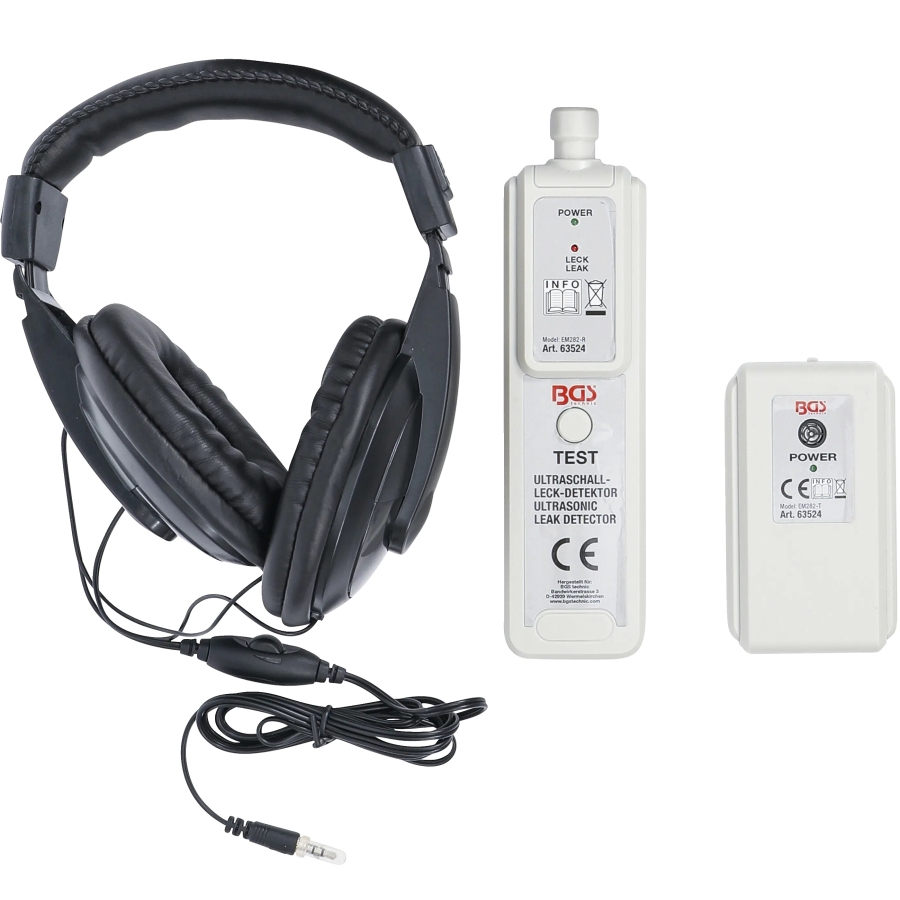
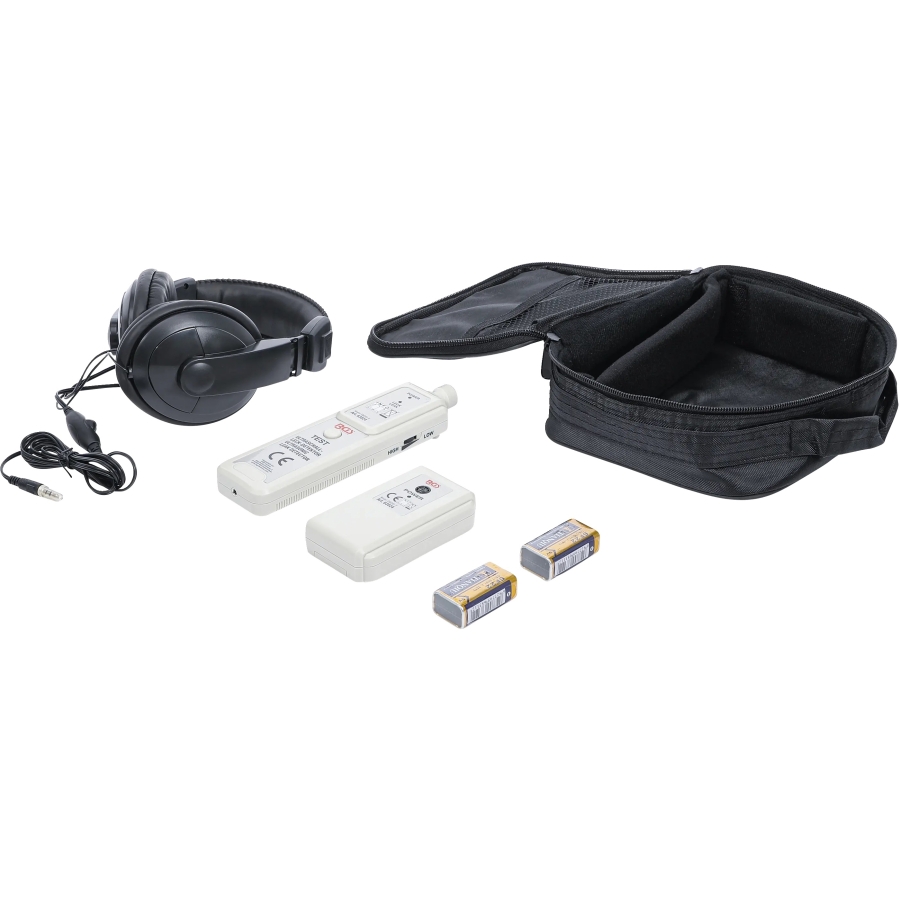
This ultrasonic leak detector is designed for reliable identification of leaks in closed systems, pressure vessels and vacuum containers. The device allows fast and accurate localization of leaks in both pressurized and non-pressurized systems.
The system uses ultrasonic technology to identify sound frequencies generated by escaping gases or air movement around leak points, making it suitable for professional workshop diagnostics and maintenance applications.
The detector includes a transmitter, receiver and headphones for precise leak localization in various environments.
Applications
Suitable for leak detection on:
- Gas systems
- Air systems
- Water containers
- Pressure vessels
- Vacuum containers
- Closed systems under pressure
- Non-pressurized systems
Features
- Reliable ultrasonic leak detection
- Optical leak indication
- Acoustic leak indication
- Compact lightweight design
- Suitable for pressurized and vacuum systems
- Easy operation and precise localization
Technical Specifications
- Product type: Ultrasonic leak detector
- Frequency response: 40 kHz ±2 kHz
- Operating temperature: 0°C to 40°C
- Relative humidity: Max. 80%
- Battery type: 9 V (6F22) or equivalent
- Dimensions: 192 × 50 × 30 mm
- Weight: Approx. 115 g including battery
Package Contents
- 1 × Ultrasonic transmitter
- 1 × Ultrasonic receiver
- 1 × Headphones
Workshop Benefits
- Fast and reliable leak detection
- Suitable for multiple system types
- Detects leaks in pressurized and vacuum applications
- Reduces troubleshooting time
- Compact solution for professional workshop use
Operating modes: Active Mode and Passive Mode. In Passive Mode, only the EM282-R is used. Passive Mode is used for detecting and locating leaks in pressure and vacuum systems. Leaks generate ultrasound, which can be detected by the EM282-R.
In systems that are not pressurized or not sufficiently pressurized, no ultrasound can be detected. In such cases, Active Mode can be used. In Active Mode, the EM282-R is used together with the EM282-T. The EM282-T is an ultrasonic transmitter.
The EM282-T transmits ultrasound into a sealed container, while the EM282-R is used to inspect the outside for leaks. This allows faults, such as defective connections and seals, to be quickly and accurately located.
Operation (Detector)
- Insert the headphone plug into the headphone jack of the EM282-R and put on the headphones.
- Press and hold the TEST button. The POWER LED will light up and a "ticking sound" will be heard through the headphones. Adjust the headphone volume and the sensitivity of the EM282-R to the desired level using the control knob.
- Press and hold the TEST button. Move the ultrasonic sensor of the EM282-R along areas where a leak is suspected. If a leak is present, the frequency of the ticking sound will increase and the LEAK LED will light up. The closer the probe is to the leak, the higher the frequency of the ticking sound.
- Repair the leak and perform a final inspection with the EM282-R.
- When leak detection is completed, release the TEST button and the device will switch off.
Notes
- Many factors influence ultrasound detection, such as pressure inside the container, the shape and size of the leak, temperature, etc. In some cases, if the leak is very small, a very high sensitivity setting on the EM282-R may be required at the beginning of the inspection.
- If the ultrasound signal is too strong and the ticking frequency becomes too high, reduce the sensitivity.
- In noisy environments, reduce sensitivity accordingly to eliminate interference from background noise.
- If the EM282-R detects ultrasound (a leak), continue checking other locations as well. This ensures that the detected signal is an actual leak and not interference.
- Since ultrasound weakens significantly with increasing distance, keep the ultrasonic sensor of the EM282-R as close as possible to suspected leak locations. If necessary, reduce the sensitivity and move the sensor slowly.
General Information (Ultrasonic Transmitter)
Leak testing on applications such as cars and boats can be performed using the EM282-T and EM282-R leak detection combination.
The EM282-T emits 40 kHz ultrasound and must be used together with the EM282-R.
Containers or interior spaces that are not pressurized or insufficiently pressurized cannot emit ultrasound at the leak point. For leak detection, switch on the EM282-T and place it inside the container or interior space. The emitted ultrasound will escape through the leak and can be quickly detected using the EM282-R.
Operating Instructions (Ultrasonic Transmitter)
- The POWER switch is used to turn the EM282-T on and off.
- After being switched on, the ultrasonic speaker continuously emits 40 kHz ultrasound.
- The POWER LED lights up when the EM282-T is switched on.
General Specifications (Ultrasonic Transmitter)
Display: LED
Operating conditions:
- Temperature: 0°C ~ 40°C
- Relative humidity: <80%
Output frequency: 40 kHz
Battery: 9V, 6F22 or equivalent
Low battery indication: POWER LED will not light up
Dimensions: 101 × 59 × 28 mm
Weight: Approx. 90 g (including battery)
Operation (Ultrasonic Transmitter)
- Turn on the EM282-T. If the POWER LED does not light up, replace the battery. Slide open the battery compartment cover, replace the battery, and close the battery compartment again.
- Place the EM282-T inside the container or interior space to be tested. The emitted ultrasound will escape through leak points or defective seals.
- Use the EM282-R to inspect the outside of the vehicle and determine whether and where a leak is present. To easily relocate the leak later, mark the leak location with a pen.